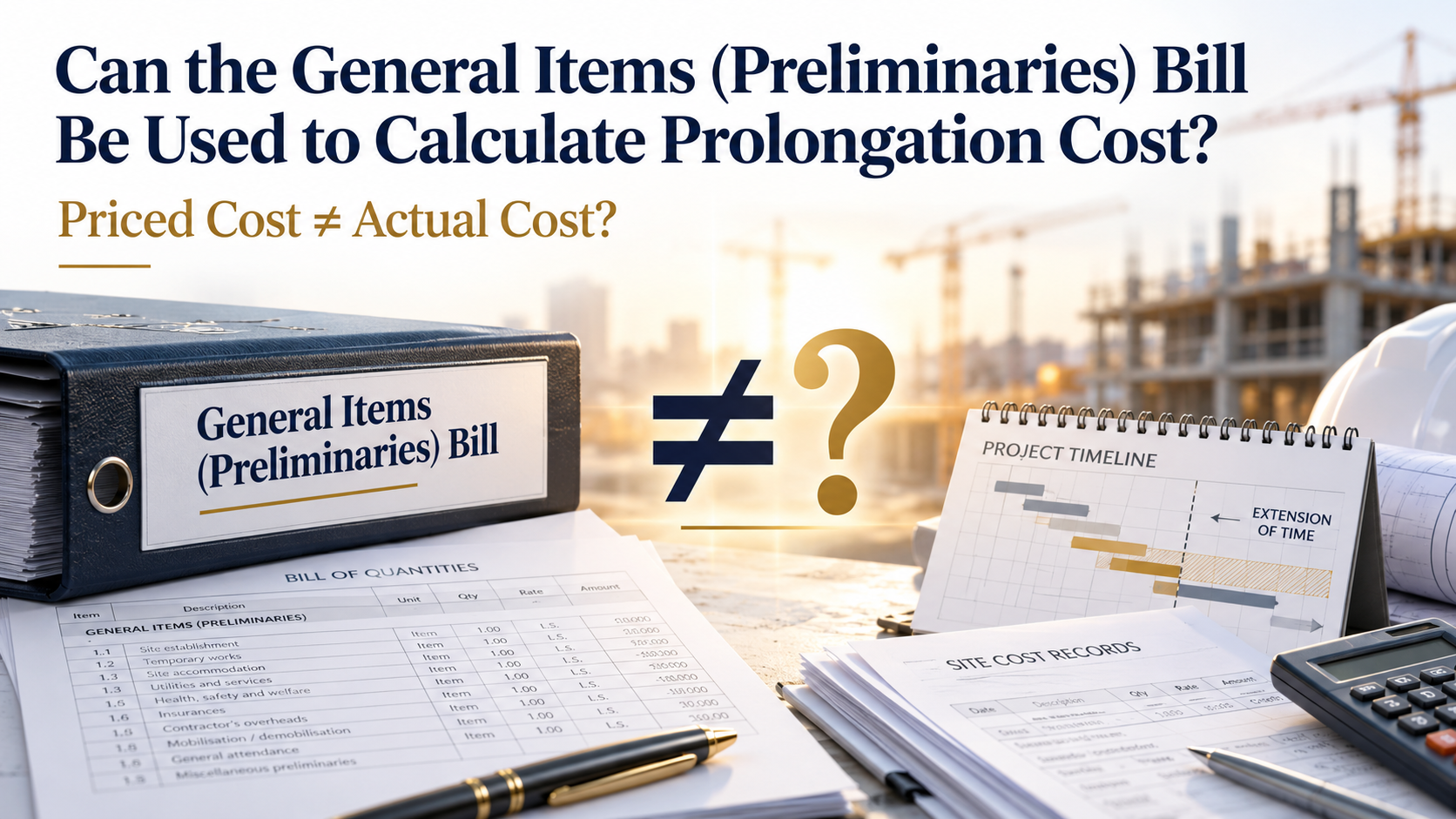
Can the General Items (Preliminaries) Bill Be Used to Calculate Prolongation Cost?
A common way of calculating prolongation cost is relatively straightforward.
Take the time-related General Items (Preliminaries) Bill, remove the fixed or one-off items, derive a monthly or daily amount, and multiply it by the period of prolongation.
For example:
Time-related General Items ÷ Original Contract Period × Prolongation Period
It looks logical. It is easy to calculate. And in many projects, it is one of the first figures considered when estimating prolongation cost.
But does that calculation establish the Contractor’s recoverable prolongation Cost?
Not necessarily.
The BOQ can tell us what the Contractor priced. It does not necessarily tell us what the prolongation cost.
The distinction is important because tender pricing and actual additional expenditure are not necessarily the same thing.
What does the General Items (Preliminaries) Bill actually represent?
The General Items (Preliminaries) Bill forms part of the Contractor’s tender pricing.
It may include allowances for site staff, accommodation, temporary facilities, vehicles, utilities, security, supervision and other project-related resources.
But a tender is a pricing exercise.
It does not necessarily reproduce, month by month, what the Contractor will actually spend during execution.
The Contractor may have:
- averaged certain costs over the original contract period;
- allocated overhead recovery across different BOQ items;
- priced some items strategically;
- under-priced or over-priced individual items;
- included allowances based on an anticipated resource profile; or
- recovered part of its project overhead through rates elsewhere in the tender.
Therefore, dividing the time-related General Items by the original contract duration may tell us the Contractor’s average tender allowance or recovery.
That does not automatically mean the Contractor incurred the same expenditure during the prolongation period.
First separate fixed items from genuinely time-related items
Not every item in the General Items (Preliminaries) Bill increases because the project takes longer.
Some costs may be predominantly fixed or one-off.
Mobilisation is an obvious example.
The initial establishment of a site office, temporary access, certain installations, surveys or similar activities may have occurred once.
Other items are more clearly time-related.
Site supervision, accommodation, vehicle hire, security, utilities and certain temporary facilities may continue while the project remains on site.
But even here, the question should not simply be:
Was this item described as time-related in the tender?
The more useful question is:
What expenditure actually continued, increased or was additionally incurred because of the compensable prolongation?
That is a different exercise.
Time-related does not mean the same cost every month
Consider site staff.
A Contractor may have priced its staff costs over a 24-month contract period.
But the staffing level throughout those 24 months is unlikely to be identical.
During peak construction, the project may carry a large engineering, commercial, safety and supervision team.
Later, some personnel may be demobilised.
Alternatively, a delaying event may occur at a stage when key resources have to be retained for much longer than originally planned.
The same principle applies to accommodation, vehicles, temporary facilities, plant and other site-related expenditure.
So a monthly rate derived from the General Items (Preliminaries) Bill is often an average.
The actual cost during the relevant period may be higher.
It may also be lower.
A simple example
Assume that the time-related General Items total:
AED 12 million
for an original contract period of:
24 months
The average tender amount becomes:
AED 500,000 per month
If the project is prolonged by four months:
AED 500,000 × 4 months = AED 2 million
Does that mean AED 2 million is automatically the Contractor’s prolongation cost?
No.
It tells us that the tender contained an average time-related allowance equivalent to AED 500,000 per month.
But during the relevant four months, the actual expenditure might have been AED 350,000 per month.
Or AED 650,000 per month.
The project circumstances during those four months matter.
What does the SCL Delay and Disruption Protocol say?
The Society of Construction Law Delay and Disruption Protocol, 2nd Edition provides useful guidance on this issue.
The Protocol makes an important distinction where prolongation compensation is being assessed on the basis of actual additional cost.
Its position is that tender allowances have limited relevance when the exercise requires assessment of the additional costs actually incurred. It also explains that an inadequate tender allowance for site overheads does not, by itself, limit the Contractor’s recovery where the contractual basis is actual cost.
But this does not mean tender allowances are useless.
The Protocol also recognises that tender allowances may provide a useful reference point in appropriate circumstances and that the parties may use them as a rough guide when agreeing or checking prolongation costs.
That distinction is particularly useful in practice.
Limited relevance does not mean no relevance.
The General Items (Preliminaries) Bill may help us understand the Contractor’s original pricing.
It may provide a reasonableness check.
It may assist negotiations.
But where the contractual basis of recovery is actual additional Cost, it should not automatically replace the assessment of what was actually incurred.
The SCL Protocol is, of course, guidance. It expressly states that it does not override the terms of the Contract or the applicable governing law.
Which period should be assessed?
There is another important issue.
Assume the original completion date was June and the revised completion date became September.
It may be tempting simply to assess prolongation expenditure during July, August and September.
But that may not always be the correct period.
The SCL Protocol recommends that, once entitlement to prolongation compensation has been established, the evaluation should relate to the period when the effect of the relevant Employer Risk Event was actually felt, rather than automatically using the extended period at the end of the Contract.
This matters because the Contractor’s resource profile may have been very different during those periods.
The financial effect of a delay experienced during peak construction could be materially different from the expenditure incurred during the final months of the project.
Again, the actual circumstances matter.
How does this sit with FIDIC 1999?
For a project under FIDIC 1999, the Contract must remain the starting point.
Before calculating prolongation Cost, the Contractor first needs to establish the contractual basis for monetary entitlement.
An Extension of Time does not automatically mean an entitlement to prolongation Cost.
The SCL Protocol itself makes the same broad distinction: entitlement to time and entitlement to compensation are not necessarily co-extensive.
Once the relevant FIDIC provision establishes an entitlement to Cost, the definition becomes important.
Under FIDIC 1999, Cost is based on expenditure reasonably incurred, or to be incurred, by the Contractor, whether on or off Site, including overhead and similar charges, but excluding profit.
That is significant.
The contractual definition is concerned with expenditure.
It does not simply say:
Use the amount included in the BOQ.
Of course, the Particular Conditions, agreed rates, specific valuation provisions or other contractual arrangements may alter the basis of assessment. Those provisions must always be checked first.
But where the entitlement is to Cost, the exercise should normally move towards the expenditure reasonably incurred because of the relevant event.
A useful sequence is:
Entitlement → Cause → Relevant Period → Additional Cost → Records
The General Items (Preliminaries) Bill may assist that exercise.
It should not automatically replace it.
So should the Contractor ignore the General Items Bill?
No.
The General Items (Preliminaries) Bill can still be useful.
It may show:
- what resources were contemplated at tender stage;
- how certain project overheads were priced;
- what level of site establishment was originally envisaged;
- whether the claimed expenditure appears broadly consistent with the tender; and
- whether there are significant differences that need explanation.
But a well-prepared prolongation cost claim should normally go beyond simply extending the tender rates.
If the claim is based on actual additional Cost, the supporting records become important.
For example:
Staff salaries and deployment records.
Accommodation costs.
Vehicles and transportation.
Temporary facilities.
Utilities.
Site support services.
Plant and equipment, where applicable.
And importantly, evidence demonstrating why those costs remained necessary because of the relevant compensable event.
A spreadsheet calculation alone does not establish causation.
The General Items Bill can nevertheless be very useful for the Engineer, PMC or Employer
Now consider the issue from another side.
A significant delay event has occurred.
The Contractor has not yet submitted a detailed prolongation cost claim.
But the Employer asks:
“What could our potential exposure be?”
The Engineer, PMC or Commercial team still needs to provide an early commercial forecast.
At that stage, the General Items (Preliminaries) Bill can be extremely useful.
The time-related items can be reviewed, an indicative monthly amount derived, and that amount applied to the potential compensable period.
It may provide a sensible high-level estimate of potential exposure until better information becomes available.
For example:
Indicative prolongation exposure: AED X–Y million, subject to entitlement, actual duration, substantiation and detailed assessment.
There is nothing inherently wrong with that approach.
In fact, from a project-controls perspective, it may be exactly what is required.
The problem arises when the same preliminary forecasting calculation is later treated as though it automatically determines the Contractor’s final contractual entitlement.
It does not.
Forecasting exposure and assessing entitlement are not the same exercise.
One is a management tool.
The other is a contractual and commercial assessment.
A practical view from each side
Contractor
Do not assume that:
monthly General Items × prolongation period = recoverable prolongation Cost.
The General Items (Preliminaries) Bill can support the claim and provide useful context, but where the contractual entitlement is to Cost, the stronger approach is to demonstrate the actual additional expenditure associated with the compensable event and relevant period.
Good contemporary records are therefore critical.
Engineer / PMC
The General Items (Preliminaries) Bill can be a useful starting point for estimating exposure and testing the reasonableness of a claim.
But distinguish between an early forecast and a detailed contractual assessment.
When the claim is submitted, examine the entitlement, causation, affected period, resources retained and actual expenditure.
Employer
The General Items (Preliminaries) Bill can provide early visibility of possible commercial exposure.
But an internal budget provision should not be mistaken for an acceptance of final liability.
Equally, the Contractor’s original tender allowance should not automatically be treated as a ceiling on recoverable Cost where the Contract provides for recovery based on expenditure reasonably incurred.
The practical takeaway
The General Items (Preliminaries) Bill is useful.
It tells us how the Contractor priced certain project-related costs.
It can provide an early benchmark.
It can assist with reasonableness checks.
And it may be useful when the parties are trying to reach a practical agreement.
But it answers a different question from an actual-cost prolongation assessment.
The key distinction remains:
The BOQ can tell us what the Contractor priced. It does not necessarily tell us what the prolongation cost.
Before multiplying a monthly General Items figure by the period of delay, ask one more question:
Are we forecasting potential exposure — or are we assessing the Contractor’s contractual entitlement?
The answer may require a very different calculation.
Prolongation Cost — Practical Online Session
I will be discussing this and other practical aspects of prolongation cost in a focused 2-hour online session.
10 October 2026
6:30 PM – 8:30 PM UAE Time
Microsoft Teams
AED 100
The session will cover the contractual basis of prolongation, admissible period, admissible costs, site-related expenditure, overhead recovery and practical assessment of a prolongation cost claim.
Register for the session → https://buy.stripe.com/cNi3cu0X0dQq2JN7lo6Zy03
Continue with Commercial Edge
This article addresses one specific practical issue around prolongation cost.
For structured learning across FIDIC 1999, Contract Administration, Variations, Claims, Procurement and Commercial Management, explore the Commercial Edge Professional Series.
Explore Commercial Edge → https://kamaldubey.com/commercial-edge/